£29.00
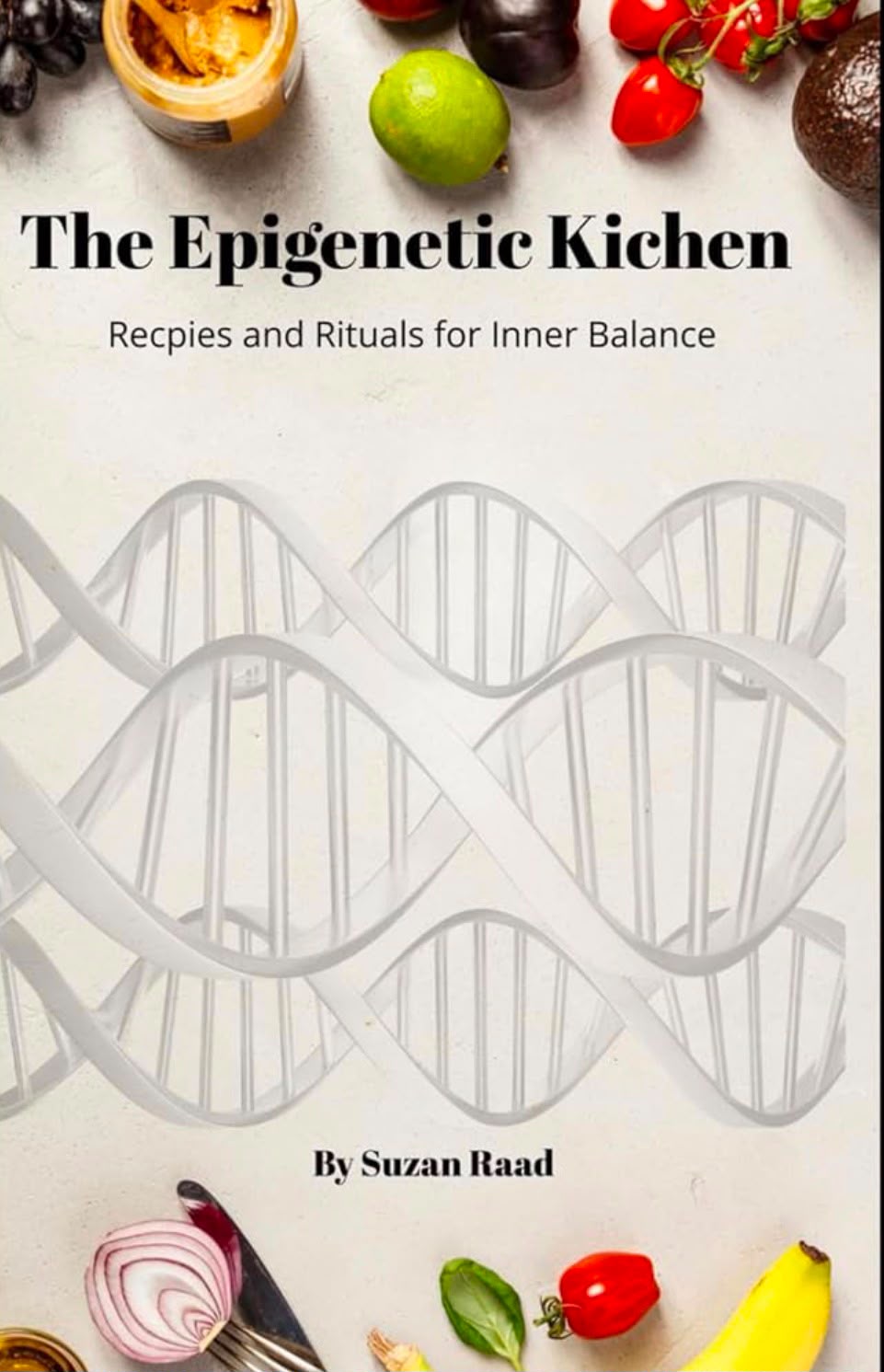
Epigenetic Diet by Suzan Raad: how everyday food choices act as signals that shape which of your genes are switched on.
Epigenetic Diet is a paperback book by Suzan Raad, a UK-based nutritionist and the author of four books on epigenetics and nutrition. It takes the science of gene expression out of the research journals and puts it where people actually make their decisions: the kitchen, the shopping list and the ordinary weekday evening.
The argument at the centre of the book is simple to state. Genes are not fixed instructions. The signals a person sends their body every day, through food, sleep, light, movement and stress, influence which genes are expressed and which stay quiet. Epigenetics is the field that studies those signals, and this book is concerned with one channel in particular: what you eat.
The book begins with the mechanism, explained in plain language and without assuming any background in biology. From there it moves into application. Rather than handing over a fixed meal plan to be followed for a set number of weeks, it sets out the reasoning behind each choice, so that a reader can adapt the approach to the food they already eat, the ingredients available where they live, and the amount of cooking they can realistically do.
Several themes recur. Whole foods are treated as more informative than isolated nutrients. Daily rhythm and repetition are given more weight than intensity. And throughout, the emphasis falls on small signals sustained over months rather than short, dramatic interventions, which is the practical conclusion Suzan Raad returns to across all four of her books.
This edition suits readers who want the reasoning as well as the instructions, and who would rather understand why a food matters than simply be told to eat it. No prior reading in genetics or nutrition science is needed. Because a paperback is a flexible format, it is easy to keep on a kitchen shelf and refer back to while cooking, which is how the material is meant to be used.
Every cell in your body carries the same DNA, yet a liver cell behaves nothing like a neuron. The difference is not the code itself but which parts of it are switched on. Chemical marks sit on top of the genome and act something like volume controls, turning the expression of particular genes up or down. That layer is what the word epigenetics describes.
Those marks are not fixed in the way the underlying sequence is. Diet, sleep, physical activity, light exposure and psychological stress have all been studied as inputs that influence gene expression. Nutrition is among the better documented of them, partly because several nutrients are directly involved in the chemistry of the marks themselves.
None of that makes food a treatment, and Epigenetic Diet does not present it as one. What the book offers is a different way of thinking about a meal: not as a number of calories, but as a set of signals arriving at the cell, several times a day, for years at a time.
The four can be read in any order and each stands on its own. Readers who want the underlying mechanism first often begin with Epigenix, and readers who want the emotional side can go to the Epigenetic Awakening hardcover. All four are listed on the books page.
Suzan Raad is a UK-based nutritionist and the author of four books on epigenetics and nutrition. Her work centres on a single idea: that genes are not fixed instructions, and that the daily signals a person sends their body, through food, sleep, light, movement and stress, influence which genes are expressed. She works one to one with clients worldwide by phone and video call, combining her books with personalised coaching programmes built around each person’s own test results. She is also a co-founder of the 360 Degree Clinic, and her books are published under the name Suzanraad.
Some readers want the material applied to their own circumstances rather than discussed in general terms. The coaching packages range from a single consultation with one follow-up call through to a longer programme that includes marker testing and monthly calls. Epigenetic Diet is a reasonable place to begin either way, since the coaching assumes no particular reading beforehand.
No. Each of the four titles stands on its own and they can be read in any order. Readers who want the underlying mechanism in more depth often begin with Epigenix, but it is not a prerequisite for this one.
No. The book is written for a general reader and explains its terms as it goes. No prior study of genetics, biochemistry or nutrition science is assumed anywhere in it.
Not in the usual sense. It sets out reasoning rather than a fixed schedule of meals, on the basis that an approach you actually understand is one you can adapt to your own kitchen and keep going with.
Yes. The one-to-one coaching packages exist for that, and range from a single consultation with one follow-up call through to a longer programme built around your own marker test results.
Paperback. It is the flexible, everyday edition, meant to be kept where you cook rather than on a shelf.
Epigenetic Diet is written as general information rather than individual advice. It sets out reasoning and leaves the application to the reader, so it suits someone willing to think about their own diet rather than follow a script. If you have a medical condition or take prescribed medication, discuss any change to your diet with your own doctor first. For guidance built around your own results, the coaching programmes are the better route, and the book is a useful companion to them.