
Epigenetic Awakening
Epigenetic Awakening is Suzan Raad’s book about the side of your biology that begins in the mind. Where her other titles look at what you eat and how you live, Epigenetic Awakening turns to thought, emotion and stress — the inner signals that are every bit as capable of shaping which of your genes are switched on and which stay silent.
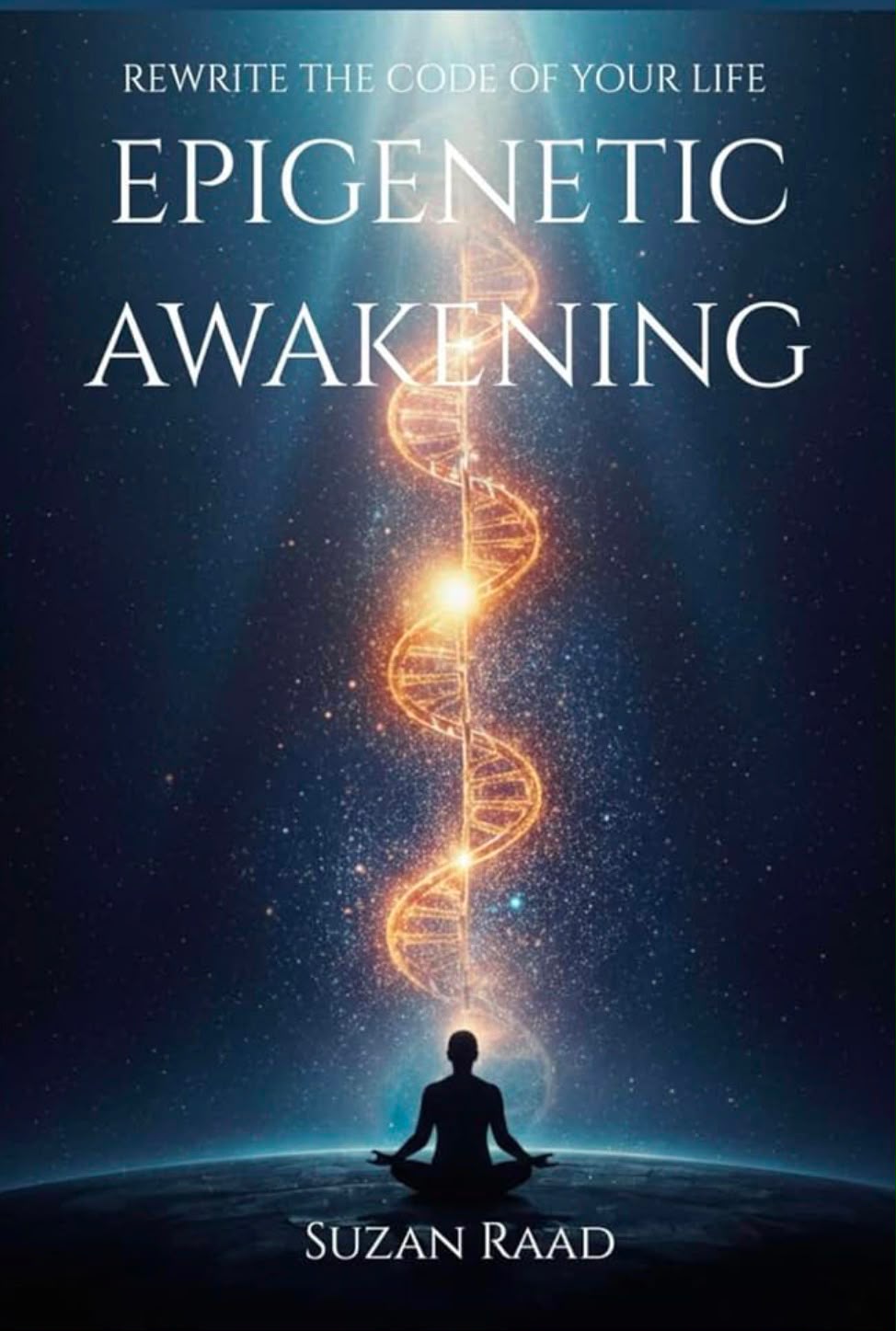
Your inner life is a signal too
Every worry, every moment of calm, every night of broken or restful sleep reaches your cells as information. Your body doesn’t draw the neat line between mental and physical that we use in conversation. Chronic stress, emotions you never quite process, and the stories you repeat to yourself all become chemistry — and that chemistry helps decide how your DNA is read. This is the territory of epigenetics, and Epigenetic Awakening is about learning to notice those signals, and slowly learning to change them.
Why awareness comes first
The awakening in the title is a shift in how you see yourself. Your genes are not a fixed sentence handed to you at birth; they are closer to a living conversation between you and your environment — the outer world of food, light and movement, and the inner world of mood, attention and belief. Once you understand that your daily experience is part of that conversation, the idea of influencing your own health stops feeling abstract and starts to feel possible.
From mindset to biology
From there, Epigenetic Awakening explores how mental habits feed back into the body: how stress patterns settle into physiology, how attention and emotional regulation matter, and why change that lasts usually grows from the inside as much as from the plate. None of this is about blaming yourself for illness, or pretending that positive thinking can override everything. It is about reclaiming the part of your health that genuinely does respond to how you live.
Who the book is for
You don’t need a background in science to read it. Epigenetic Awakening is for anyone who suspects that the way they think and feel is bound up with the way they age, heal and live — and who wants a clear, grounded way to understand that link rather than another list of rules. The tone is practical and human, not clinical, and it assumes you are intelligent and curious rather than in need of a lecture.
A different way to think about health
Most health advice treats the body as a machine to be corrected. This book asks a quieter question: what are you already telling your body, every day, without meaning to? The light you sit under, the pace you keep, the thoughts you rehearse before sleep — all of it lands. Seeing that clearly is the first, and often the hardest, step, and the book is an invitation to begin sending your body signals you have actually chosen.
Part of a bigger picture
Epigenetic Awakening sits alongside Suzan Raad’s other books. Each returns to the same central idea from a different direction: that gene expression responds to how you live. Epigenix explains the mechanism, the Epigenetic Diet brings it into the kitchen, and Back to Babylon traces its history. Epigenetic Awakening is the one that starts with the mind.
If you have ever felt that your body and your mind are more connected than the usual advice admits, Epigenetic Awakening was written for you. It is an invitation to stop treating your health as something that happens to you, and to begin seeing it as a conversation you take part in every single day — with your food, your rest, your attention and your state of mind.